

In early Japanese archaeology and history, the Yayoi period is one of the major time periods that is believed to have lasted from the 10th century B.C. to the 3rd century A.D. Bridging the prehistoric Jōmon period and the pre-dynastic Kofun period, it saw the proto-Japanese people's shift from a hunter-gatherer society to an agricultural civilization, which led to the dawn of the Iron Age in Japan.
The historical period is named after the Yayoi district in today's Bunkyo City, then called Mukaigaoka-Yayoi, where a number of terracotta vessels were unearthed in 1884. As research advanced, archaeologists concluded that the Yayoi-type pottery was a successor to the Jōmon pottery and of a separate period. On the whole, the Yayoi pottery is plainer than the Jōmon pottery, which is often decorated with elaborate patterns.
Despite its crucial role in Japanese history, the location of the original Yayoi site, or the Mukaigaoka shell midden, has been lost in the mists of time due to the redevelopment of the area that started years before the archaeologists could fully grasp its significance. Shōzō Arisaka, who first discovered the Yayoi pottery, later noted that the open field where the site was had been completely replaced by a residential neighborhood, likely by the early 1890s.
Almost a century later, in 1974, pieces of Yayoi earthenware were discovered on a small hill on the premises of the Asano campus of the University of Tokyo. Soon an archaeological dig was orchestrated, excavating a shell midden contemporary with Arisaka's findings.
While some archaeologists excitedly claimed it to be the lost site of the Mukaigaoka shell midden, the governmental authority was reluctant to confirm it, as none of its traditionally supposed locations was close to the newly discovered site. In the end, the ministry decided to designate the site as a National Historic Site under the name of the "Yayoi 2-chōme archaeological site" (chōme is a unit in Japan's address system).
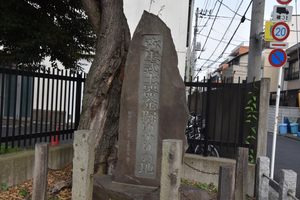
Today, the archaeological site unceremoniously lies at the back of the Asano campus, mostly covered with a blue tarp and a thick growth of weeds. All that remembers its Historic Site status is a nondescript marker standing in the corner. There is also a "Memorial to the Site of the Discovery of the Yayoi Pottery" right outside the campus, but it does not really mark the site, only commemorating the local history the best it can.
0 comments:
Post a Comment