

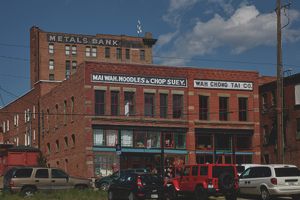
The now-faded mining town of Butte, Montana, was once known as the “Richest Hill on Earth.” The copper mining industry enticed tens of thousands of people to Butte to work under harsh conditions, including many immigrants from around the world. Thousands of Chinese workers moved to Butte beginning in 1868, establishing a thriving business district in the world’s largest mining camp, all while facing increased hostility and distrust.
While Butte remains the home of the oldest continuously operating Chinese restaurant, otherwise, very little of this history otherwise remains. The Mai Wah Society was established to preserve the history of Butte’s Chinatown, and they founded the Mai Wah Museum to house its artifacts and tell its story.
The museum comprises two buildings in Butte’s Uptown: the eponymous Mai Wah Noodle Parlor building constructed in 1909, and the Wai Chong Tai Mercantile, which served as Butte’s Chinese general store from 1899 through 1942, and is the only extant Chinese-American store that dates to the 19th century.
The museum’s exhibits tell the story of Butte’s Chinatown through its artifacts and by focusing on real people, such as the Chinn family that owned these stores, and Huie Pock, a prominent doctor who saw both white and Chinese patients. The exhibits celebrate the part of society that was unique to Chinatown and the part that assimilated into broader culture and does not shy away from the racism and rioting that led to the passage of the Chinese Exclusion Act of 1882. The Act, the first restriction on immigration in US history, was specifically targeted towards Chinese miners.
The restrictions on immigration and the general decline of Butte’s copper mining industry led many families to move to San Francisco and other more welcoming American cities over time. Although few people of Chinese heritage remain in Butte or the state of Montana, the Mai Wah Museum continues to host families and visitors who want to connect with the era, preserve and venerate Chinese cultural traditions, and tell this American story.
0 comments:
Post a Comment