

At first, the Mitaka Campus of the National Astronomical Observatory of Japan (NAOJ) simply looks like a modern research institute within a wooded area in the western suburbs of Tokyo. This appearance, however, belies the history of the campus.
Modern astronomy in Japan started in the 1880s after the Meiji Restoration, when Japan began to rapidly modernize. At first, a couple of separate observatories were established in Tokyo, but these organizations were merged in 1888 to form the Tokyo Astronomical Observatory (which would become the NAOJ a century later in 1988). The observatory acquired land in Mitaka in 1909 to build new facilities and to escape the lights from the growing Tokyo metropolis. Construction on telescope facilities started a few years later.
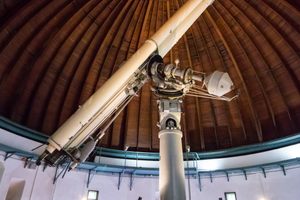
The first observatory built at the new site, named the 20-cm Telescope Dome, was completed in 1921. This was soon followed by the construction of the 65-cm Telescope Dome (now named the Observatory History Museum) and the Solar Tower Telescope (also called the Einstein Tower). Additionally, the Repsold Transit Instrument and the Gautier Meridian Circle, both of which were designed to measure the precise positions of stars as they pass through the meridian (the north-south line in the sky), were moved from other sites in Japan to the Mitaka Campus in the mid-1920s.
These observatories kick-started Japan’s involvement in international astronomy research, but the campus served another major practical purpose. From 1924 to 1955, Japan Standard Time was officially set from another transit instrument on the campus.
In the second half of the 20th century, the observatory built a couple of additional observational facilities on the Mitaka Campus, including the 6-m Millimeter-Wave Radio Telescope, which was the third telescope in the world that could observe at millimeter wavelengths, and the Photoelectric Meridian Circle, which was an updated transit instrument. However, the encroachment of Tokyo’s suburbs and the light pollution from the city made astronomical observations from the site unviable. By 2000, all of the astronomical facilities on the campus were retired from professional use.
At this point, though, people recognized the historical importance of the older observatory buildings, and several were listed by the Japanese government as Registered Tangible Cultural Properties. Additionally, the NAOJ opened the campus to the general public, set up several visitor facilities, and began to offer tours and opportunities to use the older telescopes and new ones designed specifically for public use.
However, visitors to the NAOJ’s Mitaka Campus can find more than just observatory buildings and astronomy-related exhibits. Located near the 20-cm Telescope Dome is the Tenmondai-Konai Kofun, a burial mound about 2,000 years old that dates back to the Yayoi Era. Also, the campus features a 100-year-old house that is now named the Mitaka Picture Book House in the Astronomical Observatory Forest. It currently functions as a children’s reading room and activity place.
In addition to all of these things, the NAOJ’s Mitaka Campus is simply a pleasant, green area to walk around and relax. Overall, the location is a pleasant escape from the busy streetscapes in the western suburbs of Tokyo.
0 comments:
Post a Comment