

In the spring and summer of 1989, months before the Berlin Wall fell, the Hungarian government (then quite liberal by Eastern bloc standards) decided to loosen restrictions on its border with Austria, creating the first major gap in the Iron Curtain. While Hungarian citizens were already free to travel at the time, the relaxed border conditions motivated thousands of East Germans, many of them already on holiday in Budapest or at Lake Balaton, to remain in Hungary that summer with the hope of eventually crossing over into the West.
The idea of a "Pan-European Picnic" at the Austro-Hungarian border came out of a meeting between Otto von Habsburg, a German member of the European Parliament and president of the Paneuropean Union Movement, and Ferenc Mészáros of the Hungarian Democratic Forum. It received official support from the Hungarian government, which agreed to fully open the border for a few hours during the afternoon of August 19, 1989, at the picnic site just north of Sopron.
After the picnic was announced, and unbeknownst to the organisers, thousands of German-language flyers advertising the event were circulated among the East German refugees in Hungary. Hundreds of people arrived at the picnic site on August 19 and crossed peacefully into the West, forming the largest single exodus from the Eastern bloc since the Berlin Wall was erected in 1961.
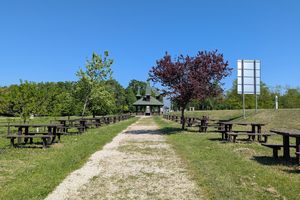
Today, the site of the Pan-European Picnic is, appropriately, a picnic ground, featuring two dozen picnic tables and a small cafe and documentation center for visitors. Multiple monuments and information boards are located around the park to tell the story of the Pan-European Picnic and remind passersby of its significance in the fall of the Iron Curtain.
0 comments:
Post a Comment